
Dothan, AL · Garage Door Service
What Your Garage Door's Age Tells Us Before We Even Look at It
Most Dothan-area garage doors date to the 1970-1999 building boom. Here's what that housing stock and moderate heat actually do to springs, openers, and tracks.
- Repairs & new doors
- Springs & openers
- Serving 8 nearby communities
What the Weather Here Does to It
The service area runs a moderate heat band, not the extreme swings you'd get further west or up in drier climates. That matters because it's not sudden freeze-thaw cracking your panels or snow load bending your track. It's steady, repeated heat-cycling on hardware that, across these 19 communities, is mostly original to houses built between 1970 and 1999 (median year 1981). Lubricant on torsion springs and rollers breaks down faster under sustained heat than it would in a cooler climate, and it does it quietly - no dramatic failure, just a spring that's lost half its life and a bearing plate that's starting to squeal. Steel panels on older one-piece and sectional doors expand and contract daily rather than seasonally out here, which loosens hinge screws and hardware fasteners over years, not storms. If your door is original to a house from that 1970s-90s wave, the heat hasn't broken it outright - it's just worn it down on a schedule nobody's been watching. We see the difference between a door that's tired and one that's actually failing, and the two don't always look different from the driveway.
When to Get Help
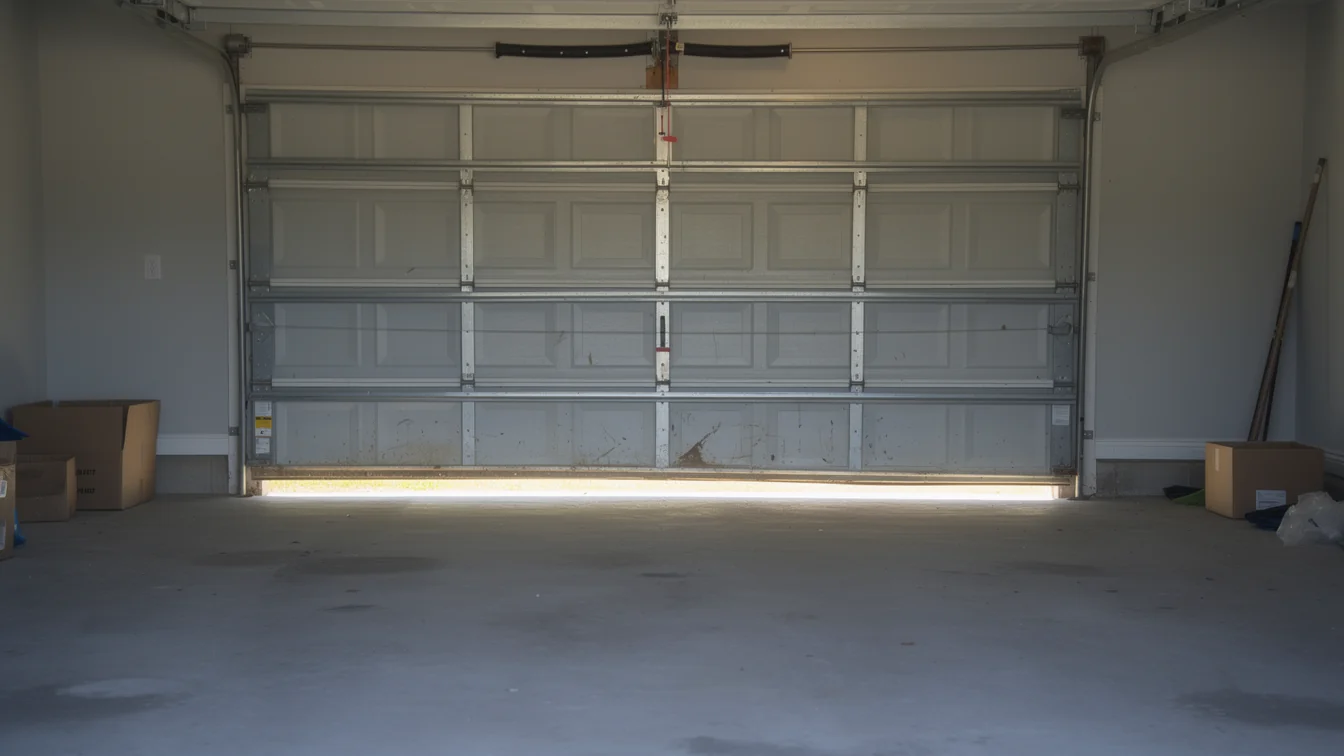
Call when the door groans, chatters, or hesitates partway through its cycle - on hardware this age, that's usually a spring giving out or a track that's worked loose from decades of thermal movement, not something that fixes itself. Call if the opener runs but the door won't seal flush at the bottom; on houses from the 1970-1999 era this is often a track alignment issue that's crept in slowly rather than happened all at once. Doors on houses built before insulation rules tend to be heavier steel or solid wood without the foam core you'd find in anything newer, which puts more strain on aging springs than most owners realize - so if a door that used to lift with one hand now needs real effort, the spring is compensating for wear, not for the door's original design. Don't wait for a cable to snap. On original hardware from this period, a fraying cable is often the last warning before something lets go while the door is open.
Leaving It Alone
Not everything needs a call. A little chalky white buildup on galvanized spring coils from the ambient humidity here is cosmetic, not structural - wipe it, don't worry about it. A door that's slightly noisier in the afternoon heat than the morning is just steel doing what steel does; that's not a sign of failure on its own. We won't tell you to replace an opener that's running fine just because it's original to a house from the 1980s - these motors were built solid, and plenty of them are still doing the job decades later with nothing more than fresh lubrication. Where we draw the line: once a torsion spring is original to a house built in that 1970-1999 window, it's well past any reasonable service life regardless of how it sounds today, and we'll say so rather than keep adjusting around it.
The Situation
Across this area - from Grimes and Cowarts in close to Headland, Ashford, and out toward Slocomb and Hartford - the housing stock skews heavily toward that same 1970s-through-90s build era, and with a median household income around $54,286 across roughly 15,655 households, a lot of owners are weighing a $150 spring job against a $600 opener replacement on hardware that's outlived its warranty by thirty years. That's a real calculation, not a sales pitch, and we'll walk you through which side of it your door actually falls on. What we won't do is push a full replacement on a door that just needs a spring and a tune-up, or quietly patch something that's actually done. One honest limitation: if your opener's circuit board is failing, we may not have the exact replacement part on the truck for an older model, and that can mean a short wait on parts rather than a same-day fix.
Frequently asked questions
Why does my garage door only act up in the afternoon?
Heat-cycling. Steel panels, torsion springs, and track brackets expand through the day and contract overnight, and components that are already worn from age show it more under that daily stress. It's common on original hardware from houses built in the 1970-1999 range, which describes most of the housing stock out here.
Is my original opener too old to trust?
Not automatically. Plenty of openers from the 1980s and 90s are still running fine with basic maintenance. What matters more than the decade it was built is whether the safety reversal and force settings still work correctly - that's what we actually check, not just the age sticker.
How far out do you go for service calls?
We work the Dothan area and the surrounding communities, including Grimes, Cowarts, Taylor, Kinsey, Webb, Midland City, Rehobeth, Headland, and out as far as Hartford and Fort Rucker. Distance affects scheduling, not whether we'll come.
My spring looks fine, why would you replace it?
A torsion spring doesn't show wear the way a frayed cable does. If it's original to a house from the 1970-1999 era, it's operated through tens of thousands of cycles already, and heat-cycling here accelerates fatigue. Looking fine and being fine aren't the same thing on hardware this old.
Related garage door services in Dothan
More garage door guides
Book garage door service in Dothan
Call now or request a quote - tell us what the door is doing and where you are.